
11xPlay Back — a Clear Walkthrough of the Live Market Row and a ₹500 Stake
Back is the side you take when you want something to happen. On an 11xPlay market row it is the first of the two prices, with the lay cell sitting immediately beside it. Tap it, type a stake, confirm — that is the whole action, and it takes about four seconds once your 11xPlay ID is open.

What a Back Bet Really Does on the 11xPlay Board
Put ₹500 into the first cell of an 11xPlay match odds row at 1.85 and you have just backed that selection. There is no more to the word than that on this board: money placed on a named thing happening. Win, and ₹925 lands in the balance. Lose, and the ₹500 goes with the row — no second charge turns up an hour later, which is the one difference from the cell sitting next to it that every new player should hold on to.
None of that changes when the sport does. An 11xPlay cricket card hands you match odds, bookmaker and the session lines; football adds over/under to its match odds; tennis, kabaddi, greyhound racing and the horse cards keep the same two-cell habit. Open any of them on 11xPlay and the back figure is still sitting on the left. Markets change. The mechanics do not.
Prices move while you read them, by the way. Whatever figure sits in an 11xPlay back cell is only the residue of the last trade, so a side that opened at 2.40 in the morning can be showing 1.70 by the toss. You are not forced to accept the number on screen. Ask for better, though, and you join a queue — which is a whole section of its own further down this page.
Risk on a back bet is capped at the figure in the stake box. Nothing else. A player who types 500 can lose 500 and no more, which is why most people who open a new 11xPlay ID start on the back side before they touch anything else.
Session lines are the ones that confuse first-timers, because there you are backing a run figure rather than a team — the outcome is a number being passed, not a side winning. Casino rounds work differently again; on the 11xPlay game lobby there is no back and lay pair at all, just a stake and a result. So the back column belongs to the sports book, and only there.
Reading a Live 11xPlay Market Row, Field by Field
A row looks crowded the first time. It is really only five things, left to right, and once you can name all five the rest of the 11xPlay board reads itself.
- The selection. A team name, a player name, or a run figure. This is what you are backing or laying. Nothing on the 11xPlay row means anything until you have read this cell.
- The back cell. The price available to you right now, with a smaller figure under it showing how much money is sitting at that price. Take the whole amount and the price moves.
- The lay cell. Immediately to the right, always a slightly higher number. Same selection, opposite side.
- The stake box. It opens the second you tap either cell, and it draws on your 11xPlay balance — which starts from a ₹100 minimum deposit by UPI, IMPS or bank transfer.
- The confirm strip. Shows the return before you commit, not after. Read it, then press.
Desktop and phone show the same five fields, only stacked differently — on a phone the stake box drops under the two price cells instead of sitting beside them. Same row, same reading order. Anyone moving between a laptop at home and the 11xPlay app on a train recognises the layout straight away.
Two habits save trouble later. Read the smaller figure under the 11xPlay back price before you type anything large, because that number is the ceiling on what can match straight away. And check the selection cell twice on fancy markets, where three rows look almost identical and only the run figure tells them apart. One misread row is how a perfectly good bet ends up on the wrong line.
Nothing on an 11xPlay row hides behind a menu, and no field asks you for anything the desk has not already given you. Five cells, one tap, done.
How the 11xPlay Back and Lay Columns Sit Together on One Clear Row
Back and lay are two halves of the same trade. One player backs, another lays, and the the market matches them against each other — that is what makes 11xPlay an exchange rather than a fixed-price book. The house is not your opponent here. Another account is.
Those two prices are never identical. Back sits a little below, lay a little above, and the small gap between them is simply where the market has not settled on one number yet. On a busy IPL match odds market that gap narrows to a hair. On a quiet greyhound race it can be wide enough to notice.
You are free to sit on either side of any 11xPlay market. Back Chennai at 1.85 now, lay the same team at 1.72 an hour later, and you have taken both positions on one selection. Traders do this constantly through an innings.
Why show both columns at all? Because a back bet is meaningless without a lay bet behind it. Somebody has to want the opposite outcome badly enough to put money on it, and 11xPlay simply puts the two offers on one row instead of hiding one of them. That is also why prices here shift on their own through the day — they are being pushed by accounts, not set by a trader in an office.
Most people never bother. Backing alone is enough for the vast majority of 11xPlay accounts, and there is nothing wrong with staying on that side for years.

11xPlay Back Stake and Returns — the Real Maths on a ₹500 Bet
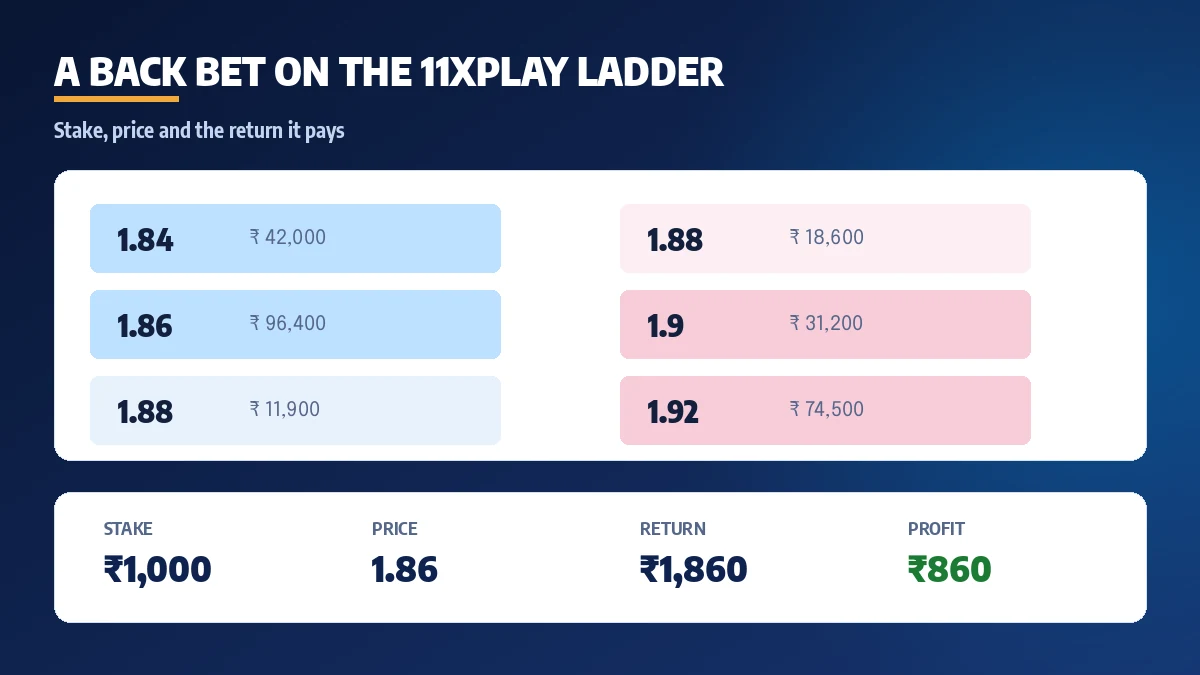
Decimal prices already include your stake, which trips up almost everybody once. Back at 1.85 with ₹500 and the figure that comes back is ₹925, not ₹1,425. Profit is ₹425. Here is the same sum at the top-up amounts most 11xPlay players actually use.
| Back price | Stake | Returned if it wins | Profit |
|---|---|---|---|
| 1.85 | ₹500 | ₹925 | ₹425 |
| 2.10 | ₹1,000 | ₹2,100 | ₹1,100 |
| 2.50 | ₹2,000 | ₹5,000 | ₹3,000 |
| 3.40 | ₹500 | ₹1,700 | ₹1,200 |
Multiply, then subtract the stake if you want the profit on its own. The 11xPlay confirm strip does that arithmetic for you anyway, so the table above is mostly there so the number does not surprise you the first time.
Odds shorten and drift while you are deciding, which catches people mid-tap. If the price changes underneath you, the 11xPlay confirm strip says so and waits — it locks the number on screen when you press, not the one you were looking at a minute earlier. Accept the new figure or back out. Nothing is pushed through at a price you never agreed to, and that single behaviour is worth more than any calculator.
One more thing about stake size. The ₹100 minimum applies to a deposit, not to a bet — individual 11xPlay markets set their own small floor, and on a thin greyhound line that floor can be higher than you expect. Check the strip.
Round numbers help more than they should. Most 11xPlay players top up at 500, 1,000 or 2,000 because the sums stay in your head at those figures — 1,000 at 2.10 is 2,100, and you do not need a calculator to sanity-check it. Deposits arrive by UPI, IMPS or bank transfer, the floor is ₹100, and the balance shows on the 11xPlay board a minute or two after the transfer lands. What you stake after that is your own business.
What 11xPlay Settlement Does to a Winning Back Bet
Settlement is the quiet part. When the result is confirmed the 11xPlay market closes, its marked as settled, and every matched back and lay on it resolves at once. Winners are credited, losing stakes are written off, and the balance on your account screen changes without you refreshing anything.
Timing depends on the market rather than the desk. Match odds settle when the match is officially over. Session lines settle the moment that block of overs ends, which is why a session can pay out while the game itself is still an hour from finishing. Fancy lines behave the same way.
Abandoned games are the awkward case, and a wet September in India produces plenty of them. Any market that never gets a result usually voids rather than losing, the stake comes back to the 11xPlay balance, and the row drops off your open list without a payout either way. Nothing to claim, nothing to chase.
Getting that balance out is the slower half, and it is worth separating the two in your head. An 11xPlay withdrawal request goes to the desk, the desk approves it, and UPI moves the money — 20 to 45 minutes end to end on a normal evening. On a final-over night, when half of India is cashing out at once, it can stretch past the hour. Nobody at 11xPlay pretends otherwise.
Should a settlement ever look wrong to you — it happens, usually when a session line and the match odds resolve hours apart and the order confuses people — message the 11xPlay desk with the market name and the time you placed the bet. Staffed 24x7 means exactly that, including at three in the morning during an away tour. The support line is +91 81097 11726 if you would rather keep it saved.
Your settled bets, your open positions and your pending payout all sit on the 11xPlay Pro dashboard, which is the screen worth learning early.
Matched and Unmatched 11xPlay Back Bets — a Quick Read
Until somebody lays it, a back bet does not really count. Until then it is unmatched, and an unmatched bet is not a bet — it is an offer sitting in the queue at the price you asked for.
Take the price showing in the 11xPlay back cell and matching is usually instant, because that price exists precisely because money is already waiting there. Ask for better than the board is offering and you wait. Sometimes the market drifts your way and fills you; more often the moment passes and you are left holding an offer that nobody wants.
Unmatched stakes are not deducted. The amount is earmarked, not spent, and the second a market suspends or closes with your offer still open, the full figure returns to your 11xPlay balance. This catches people out more often then the settlement rules do, honestly — they see a smaller available balance mid-innings and assume something has gone wrong.
One detail almost everybody misses: the queue is ordered by price, not by who asked first. A back offer at a keener number gets taken ahead of yours, however long yours has been sitting on the 11xPlay board. Shift your figure by a single tick and you jump the entire line.
Pulling an offer back costs nothing. An unmatched 11xPlay bet can be cancelled while it sits there, and the earmarked amount is free again the moment you do it. Players who trade an innings do this constantly — put a price up, watch two overs, pull it, put a different one up.
Partial matching is normal too. Ask for ₹2,000 at a price where only ₹700 is available and 11xPlay will match the 700 and leave 1,300 queued. Two lines in your bet list, one selection.
Backing 11xPlay Live In-Play Prices Over by Over
In-play is where the back column earns its keep. Prices on the 11xPlay live board move after almost every delivery, and a team that was 1.85 before an over can be 1.40 after a six and a dropped catch.
Around each delivery the market suspends for a few seconds — that pause is deliberate, and it stops bets being matched at a price the ball has already killed. It reopens at the new number. Back cells you were staring at will simply be a different figure when it comes back, which is normal and not a glitch.
In practice this means in-play backing on 11xPlay rewards patience more than speed. Waiting three overs for a price to drift is a real tactic. Chasing a number down the screen is how people lose a ₹1,000 stake in four minutes.
Cadence differs by sport, and that is the bit worth internalising. A T20 gives you roughly one repricing every thirty seconds across the 11xPlay board, which is frantic. A Test match gives you a whole session to think about the same decision. Greyhound and horse racing barely have an in-play phase at all — the race is done before a second repricing lands, so those markets are effectively pre-off only.
Football, tennis and kabaddi in-play markets on 11xPlay run on the same pattern — suspend, reprice, reopen — just with different triggers. A goal, a broken serve, a raid point.
None of this changes the job the back cell does. In-play or pre-match, on cricket or on kabaddi, the 11xPlay back cell does the same job it did in the opening line of this page: it stakes that something will happen, at the price on screen, for the amount in the box. Everything else is timing.
Most Asked 11xPlay Back Questions, Answered by the 24x7 Desk
How does a back bet work on 11xPlay?
A back bet on 11xPlay stakes that a named outcome will happen. You tap the back cell on a market row, type a stake, and confirm. If the outcome lands, the desk returns your stake multiplied by the price you took. If it does not land, only that stake is lost.
Is 11xPlay back the same as betting on a team to win?
On a match odds market, yes. Backing a team on 11xPlay is a bet on that team winning. On a session or fancy line the same back cell stakes on a run figure being passed instead, and on an over or under football market it backs the goal total.
How long does an 11xPlay back bet take to settle?
Most 11xPlay markets settle within minutes of the result being confirmed, and the balance updates on its own. Withdrawing that balance is the slower half: UPI payouts reach the bank in 20 to 45 minutes, and a final-over rush at night can push it past an hour.
Can I place an 11xPlay back bet during a live match?
Yes. The 11xPlay in-play board keeps back and lay prices open through the innings, and they move after almost every delivery. The market suspends for a few seconds around each ball, then reopens at a fresh price. Unmatched bets simply wait for someone to take them.